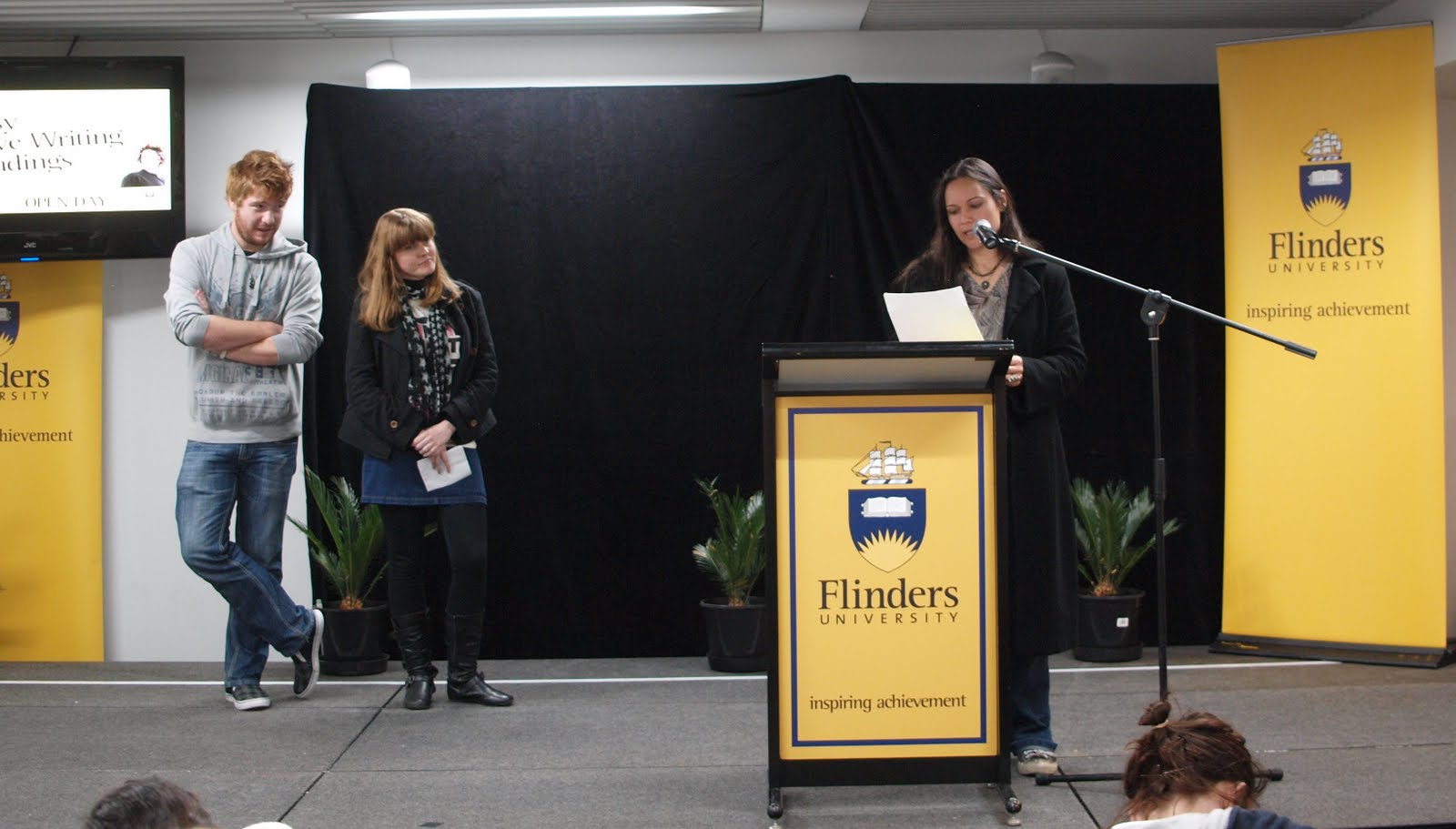
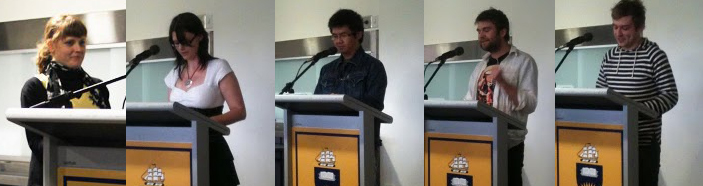
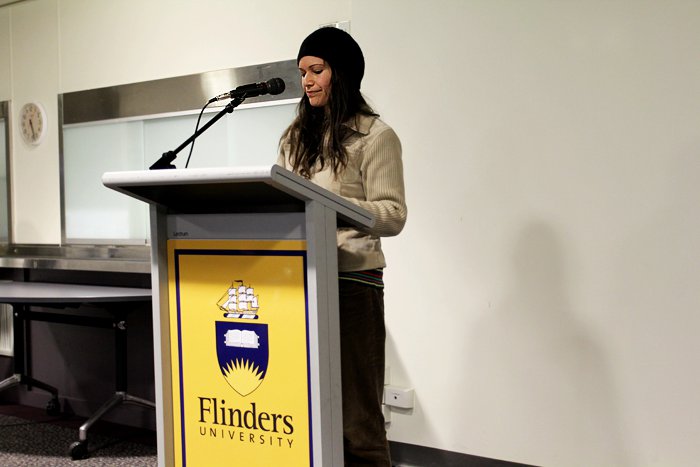
Flinders Postgrad Tom Drahos on vox, well-known Adelaide Metal Scene figure Tim Giddings on guitar, Adelaide University sound tech student Meredith Lane on bass, and former Flinders University Arts/Science student James Kerr on drums, who has since been travelling the world.
Speakeasy supported five Flinders Creative Writing students reading at Mostly Books, Mitcham Square on Saturday September 17. The event was part of the Australia Council's 'Get Reading' promotion and took place in store.
Flinders creative writers, Samuel Williams, Alicia Carter, Peter Beaglehole, Mario Pilla, and Delana Carbone, entertained Saturday morning shoppers with their best work. They read five minutes of their own writing, and then, to fit with the theme of a celebration of reading, read a five-minute excerpt from their favourite book.
Lisa L. Hannett describes herself as a writer of speculative
fiction of the creepy and unsettling kind. Certainly, her debut book of short
stories, Bluegrass Symphony, sits
neatly with this description. However, the stories collected here surpass the
merely creepy and unsettling. Bluegrass
Symphony is also a collection of stories of extraordinary beauty and depth.
Part speculative fiction, part southern gothic, the worlds Hannett conjures are
full of disturbing tales of tricksters and lost souls in landscapes that are at
once familiar and eerily strange.
She began her
career as a writer only a few short years ago, but in that time her stories
have appeared in Clarkesworld, Weird Tales, Shimmer, Fantasy and Electric Velocipede, to name but a few.
‘The February Dragon’, co-written with Angela Slatter, won the 2010 Aurealis
Award for Best Fantasy Short Story, and Hannett will be teaming up with Slatter again in her second collection of short stories, Midnight and Moonshine, to be published in 2012.
Creative writing is
something you've only been doing for about three years. When did you begin to
think of yourself as a writer?
When I got my first rejection. I mean, I'd been jotting down
notes, working out plots, building worlds, creating characters for a while. I
had a totally lame epic fantasy in the desk drawer, and a stack of tragic poems
(we all go through that tragic poetry phase, right?) but I was doing it all
privately. Secretly, even. It wasn't until I went through the process of
sending out a story, waiting to hear from the editor, trying not to think about hearing from the
editor, getting rejected — and then immediately setting myself up to do it all
again — that I felt I was really a
writer.
When you write is there a fully formed
plot structure in your mind, or do you find your way as you write?
It depends on the story, really. Occasionally I know the
whole thing in advance, and the process of writing is not much more than
transcribing a piece that has (miraculously) appeared fully formed in my mind.
Those writing days are gold (and sporadic!) More frequently, I know the
beginning and I know the ending – and then it takes a while to work out the
middle bits. You know, the part where the story happens... Most of the time,
though, I know what the ending is going to be – right down to the way the final
line will be phrased – and so I work backwards from there, until I figure out
where the narrative is meant to begin. Having said that, I often just have an
image in my mind – like for ‘Carousel’, for instance, I had a vision of a girl
surrounded by moths and nothing else – and then the story comes later.
Did each of these stories begin with the
same narrative perspective they have in their published versions, or did you
have to play around with voice?
The short answer is – yes. I spend a lot of time thinking about the story
before I set it down, and just as much time working on the opening scene, and
even more time writing the piece in full. So any playing with narrative
perspective happens, in the first instance, when I’m daydreaming about the
story; that way, when I start to write the first scenes, I’ve already got an
idea of what the character will sound like. Hesteh’s voice in ‘Them Little Shinin
Things’ was there right from the beginning and, as crazy as it sounds, her mood
and personality shaped the plot. Same thing with Jesse in ‘Down the Hollow’ –
when I was jotting notes down for these stories, the narrators came out
sounding just the way they do in the final versions. I’m often happiest writing
in the third-person, so I’ll set myself challenges (write in the first-person,
write in the second-person, that kind of thing) and then stick to it until the
story works. There are so many times when I think it would be incredibly
freeing to be a spontaneous writer, one who scribbles things down quickly and
then rewrites the entire work from a different point of view. But instead, I
write slowly and consider how the characters will sound, what the tone of the
piece will be like, the imagery it will draw upon, right from the word go. Nine
times out of ten, the final version of the story is virtually the first draft,
with a few tweaks to get rid of repetitions. It’s a slow way to write, but cuts
back on the time spent editing.
Which other writers,
contemporary or otherwise, inspire you?
This is such a hard question to answer because there are so
many! Gah! In terms of style, I’m perpetually inspired by Margaret Atwood (i.e.
I am blindingly passionate about her turns of phrase, in everything she’s
written – apart from Year of the Flood);
ditto Virginia Woolf; ditto Michael Cunningham; ditto David Malouf; ditto
Robert Shearman (particularly Tiny Deaths).
In terms of characterisation, I constantly think about Flaubert’s Madame Bovary; Susanna Clarke’s Jonathan Strange & Mr Norrell;
Michael Chabon’s The Amazing Adventures
of Kavalier & Clay; Patricia Highsmith’s Talented Mr Ripley; Jeff VanderMeer’s Finch. In terms of setting and atmosphere, Shirley Jackson, E.
Annie Proulx, Timothy Findley...
You point out that 'Commonplace
Sacrifices' was published first in On Spec. Did you write the other stories
with the idea of a collection in mind, or did you have so many stories you
decided to do a collection?
I wrote a couple of these stories before I realised that there was a
collection’s worth of stuff I wanted to do in this world. Ideas starting coming
left, right and centre, so after writing two or three stories I thought I’d
just go with it... And then I was lucky enough to get a contract for a solo
collection, so instead of filling it with reprints of stories I’d already had
published I decided to take a chance and put out a book of originals. To be
honest, I love this world so much I think I could probably fill another
collection.
All the stories in
this collection are tied together with a sense of place. How important is
landscape in shaping your stories?
There are two types of fantasy writers: those who are initially inspired by
characters, and those who are initially inspired by other worlds. Every story
needs to have a great mix of both, and every writer will (or should) devote as
much time to shaping three-dimensional characters as s/he does to shaping
believable worlds. But at first – when that first inkling of a tale creeps into
your mind – you’ll either hear a character speaking to you, or you’ll imagine a
new world, and the story will develop from that initial spark. I think it’s
fair to say that I’d fall into the latter category. Landscape, world-building,
setting – whatever you want to call it – makes writing exciting. I love
thinking about the restrictions inherent in fictional worlds, their politics,
their weather patterns, the migratory habits of their birds – everything that
make the ‘real’ world seem real, but in fantasy these elements always come with
a twist. And I’m inspired by cold, harsh climates (probably because I grew up
in Canada) as well as huge, complicated worlds (probably because I grew up on
Earth.)
The stories are full
of myth and legend. In a story like 'Fur and Feathers', for example, are there
folk stories or fairy tales you've drawn on for inspiration?
Not explicitly. I have always read a lot of fairy and folk
tales, so it’s not a surprise that mythic elements seep into my work. And I’ve
always been fond of Trickster narratives, whether in traditional folklore or in
new fantasy (such as Charles de Lint’s novels) so I was happy when Reynard made
an appearance in ‘Fur and Feathers’ – and when Tricksters showed up in ‘To Snuff
a Flame’ (which also has a flavour of ‘Red Riding Hood’ in a weird way).
You have a background in photography and
fine arts. How important was it to you to have a say in the design of Bluegrass
Symphony?
It’s quite unusual for authors to get a say in the art for
their books, and I didn’t expect things to be any different in my case. But
when I got the opportunity to work on the cover, I took it. My background in
Fine Arts does influence the way I look at things – I’m probably overly picky
when it comes to judging covers – but it’s this aesthetic combined with my
background as a bookseller that makes me feel so strongly about book design.
There are so many great stories that will never be read because they are
encased in hideous graphics and labelled with hideous fonts. No matter what
people say, we do judge a book by its
cover – if this weren’t the case, we’d all have books wrapped in brown paper on
our shelves. So it was incredibly important that I got to voice my opinions
about the cover for Bluegrass Symphony,
and also incredibly lucky that the publisher was gracious enough not to be
insulted when I bagged the first version he’d suggested...
Flinders students! Keep checking the blog and watch for
posters with our next call-out for readers. Our next FlindersUniversity
on campus event is on 11/11/11.
Lisa L Hannett is a writer of speculative fiction, largely of the creepy or unsettling variety. She is also a graduate of Clarion South.
Her short stories have appeared in venues including ClarkesworldMagazine, Fantasy Magazine, Weird Tales, ChiZine, Midnight Echo, Electric Velocipede, Tesseracts 14, Shimmer and Ann & Jeff VanderMeer’s Steampunk Reloaded, among other places. Her story ‘On the Lot and In the Air’ was recommended on Locus’s Recommended Reading List for 2009; ‘Commonplace Sacrifices’ was on Tangent Online’s Recommended Reading List for 2010; ‘Soil From My Fingers’ will appear in The Year’s Best Australian Fantasy and Horror 2010, and ‘The February Dragon’, co-written with Angela Slatter, won the ‘Best Fantasy Short Story’ Aurealis Award for 2010.
Her first collection of short stories, Bluegrass Symphony, was recently published by Ticonderoga Publications in August 2011. It deals with cowboys and fallow fields, shapeshifters and rednecks, superstitions and realities in harsh prairie country — and a whole bunch of other things thrown in the mix.
Her second collection, Midnight and Moonshine (co-authored with Angela Slatter) will be published in November 2012.
Gay Lynch
Gay Lynch teaches creative writing and English at Flinders University. Her research areas include Irish-Australian history, contemporary literature, and creative writing pedagogy. She has published educational children's texts, short stories, and a novel and, most recently, an essay on Irish-Australian convict playwright, Edward Geoghegan (1812-1869).
Speakeasy Creative Readings gives Flinders students the opportunity to share their work with the world. The next Speakeasy public event will feature
Flinders University’s most talented creative
writers including special guests Lisa L. Hannett, who will be reading from her
first book of short stories, 'Bluegrass
Symphony', and Flinder's own talented author and lecturer Gay Lynch.
Reading with Lisa and Gay will be nine talented Flinders undergraduate creative writers, with musical entertainment provided throughout the night by 'The Interludes Rock Respectably'.
Wed, 21 Sep 2011, 06:00PM Wheatsheaf Hotel, 39 George St, Thebarton, SA Gold coin entry
Why not come along and check out the creative talent that Flinders has to offer?
More details on the Headliners and a fabulous interview with Lisa Hannett will be up on the blog soon.
!!Special thanks to the artful poster-making
talents of Lisa Train for yet another great Speakeasy poster!
On the 27th of May 2011 was scheduled an event so grand and glorious that twice the Masters of Ceremony were required to keep everything under control. We, Samuel Williams and Mario Pilla, were reluctant heroes, but after much persuasion, dutifully pledged ourselves to the roles of host and reviewer for this day of days — this Speakeasy of Speakeasys. Imagine our embarrassment when we arrived in nigh identical attire: an integrative display of formalwear and lazywear. Yet despite wardrobe surprises, the show went on, and to great success.
Our courageous Flinders writers were able to decisively debunk that age-old myth – that writers are solitary creatures who find interaction with real human beings baffling – and they did indeed make speaking look easy. Determined not to be outmatched by the free wine and chips, they served up a delicious menu of prose, poetry and drama, and took great pleasure in fusing the flavours of all three. Troy Benson delivered an especially dramatic poetry reading, hunched over the microphone while hissing his lines at a breathless pace. Marcus Doherty slipped in and out of character to read both parts of his script – a feat made easy by the sheer breadth of expression conveyed in his eyebrows. Miles Trench’s Imprints-prize-winning piece ‘Quick’ breathed poetic life into what looked like a paragraph of prose. There was even a surprise appearance by Russian dramatist and novelist Nikolai Gogol, channelled by Dennis Wild.
As the wine flowed and reader after reader took to the stage, the atmosphere became so welcoming that even the smallest member of the audience couldn’t resist joining the festivities with a display of her pram-pushing prowess. Works ranged from the gory and the chilling – tales of carnivorous circuses, blazing evocations of self-immolation and the unspeakable, yet spoken, horror of ducks – to the uplifting and uproarious – lyrical love poetry, and all-too-true accounts of airline travel.
It has been a pleasure to watch the Speakeasy movement grow from a humble gathering of students and academics into a burgeoning Flinders tradition. Under the guidance of our tireless committee, Speakeasy is becoming more than simply an opportunity for students to read their work in a relaxed and supportive environment – it is connecting young writers with student magazines, local literary journals and even writers festivals. In addition to showcasing undergraduate creative writing at the upcoming Flinders Open Days in August, Speakeasy public readings at the Wheatsheaf hotel in September, there is also a rumor that Speakeasy readers may be sharing their talents with audiences at Adelaide Writers Week in 2011. We know these developments would have made Fabienne Bayet-Charlton, a founding member of the Speakeasy committee who is tragically no longer with us, very proud. Fab reviewed the first ever Speakeasy we attended, and (in addition to delivering a much more punctual review than either of us could manage) she did us the favour of summing up our sentiments perfectly: 'It's a luxury to travel together when traditionally writing and reading are solitary practices, so thank you for the journey.' We look forward to seeing where this journey will take us, and our fellow students, in the years to come.
Reviewers:
Samuel Williams is a second year student in the Bachelor of Creative Arts (Creative Writing) at Flinders University and an overenthusiastic bookseller at Mostly Books. His fiction has been published in Voiceworks magazine and this year he was a judge for the ABA's Indie Book Award in the Debut Fiction category. He hopes to work somewhere in the book industry after graduating - ideally as an author.
Mario Pilla's a second-and-a-half year Bachelor of Creative Arts (Creative Writing) student at Flinders University.
Miles writes poetry and short stories. He has completed an Advanced Diploma of Professional Writing and is now into his third year of a Bed/BA at Flinders uni.
He has also written Holistic Gardening – The Five Principles of Success. His favourite authors are Faulkner and Steinbeck. He hopes one day to complete and publish his novella Runcifal (a horror fantasy).
Mario Pilla
Mario is a second year BCA student. He's of a Salingerian modesty, and has never sent off any work to be published - but he has performed his stories publicly on three separate occasions, and is about to so a fourth time.
Barbara Brown
Alicia Carter
Alicia often complains that she never wins anything. However, since becoming involved in Speakeasy she's won two things. Most recently The Imprints Booksellers Fiction Prize for her short story 'Saturn Devouring His Son' and, previous to that, a can of asparagus soup. She hopes to win at least more soup in the future.
Mel Manson
Mel is a second year first year student and a first year second year student... she's either really clever or somewhat confused. In her shortish life, Mel has overcome alcohol, nicotine, and fundamentalism. Now she refuses to indulge stupidity for the sake of tradition. Surely, we can find a better reason than that. Mel would like to write stories that make people want to blow up parliament and run for prime minister all at the same time. However, she's not really a writer, so, she comes to Speakeasy in the hopes of meeting someone who'll do it for her.
Tami Milne
Hannah Kent
Samuel Williams
Samuel Williams is a second year BCA creative writer. His work has been published in Voiceworks magazine, and this year he was a judge for the third annual Indie book award in the Debut Fiction category.
Tom Drahos
Tom is a creative writing postgrad at Flinders University. He recommends that you watch the films Irreversible, Antichrist, and A Serbian Film. The cinematography in these films is breathtaking. Especially A Serbian Film. Such beauty.
David Sornig
Many thanks to Delana Carbone of Libertine Magazine for taking these great pictures.
On behalf of the Speakeasy committee, the captivated audiences, and our fabulous readers, I’d like to thank co-director Margot McGovern for all her enthusiasm and hard work over this last couple of years. Margot has left us for an exciting adventure in Dubai and will be missed.
Because of her enthusiasm, support and flair for event planning, we have been able to build an arts community infrastructure for Flinders University students. Margot’s initial enthusiasm helped to develop this project from an idea, and her consistent support with planning and her dedication to providing opportunities for Flinders students has assisted us in making Speakeasy the thriving entity that it is today.
We’d like to wish Margot all the best in the future as Speakeasy moves into a new chapter.
It was a clear Autumn evening when we all gathered once again—friends, family and followers—for the latest Flinders University Speakeasy Creative Readings. Yes, the stars were bright in the sky, and the fairy lights of the Wheatsheaf Shed’s stage were twinkling beautifully as ever; but the real stars of the night were the readers.
Another incredible array of creative writing talent kept us enthralled with their tales of love, loss, lust, survival, murder and a bit of comedy for good measure. Ranging from nineteenth century Iceland, through to post-war Berlin, and finally to the contemporary angst of suburbia and a war-zone, these readers and their writings gave us an insight into the human condition in all its various guises. The performances were poignant, startling, entertaining and always well delivered. As a creative writer myself, and one who has also stood on that stage staring out into the blackness, the opportunity to perform a piece of written work is one filled with dread but also excitement. To be able to read aloud your own work to a captive audience, with the rhythm and nuances that reading alone sometimes neglects, is a powerful tool in the creative process, enabling both reader and audience to participate in the performance. And this latest Flinders University Speakeasy was no exception.
Experienced readers such as Miles Trench, Mario Pilla, Sam Williams and Tom Drahos entertained us with their stories of contemporary angst and the writing and studying dilemma. Alicia Carter, Mel Manson and Tami Milne also gave great deliveries of well-written pieces about the trials and tribulations of life in suburbia. First time reader and one of our headliners, Barbara Brown, gave a moving performance of life as a small ‘rubble’ girl in post-war Berlin, while Hannah Kent, another of our headliners, dramatically enacted the thoughts of a female nineteenth century farm worker, given the task of watching over the last woman condemned to death in Iceland. Published author, David Sornig, ended the evening for us, relaying a story of male angst in a contemporary war zone, with the well-known sound of planes flying over The Wheatsheaf in the background giving the reading an eerie reality. Congratulations to Peter Beaglehole, MC for the evening, who kept the night moving along, giving us plenty of warning and time to order pizzas and visit the bar, not to mention his witty observations and anecdotes.
Another Flinders University Speakeasy success! And after the raffle was drawn and prizes handed out, which included copies of two outstanding Australian literary journals—not bad for a night of free entertainment—we all gathered round to congratulate the readers and organisers for this well-attended and supported, soon to be iconic, literary event. I can’t wait for the next one. Be there or be square.
Review by Amanda Williams
Amanda Williams is currently completing a Masters Degree in Creative Writing at Flinders University, working on a coming of age novella set in the seventies on the Lefevre Peninsula.

 Lisa L. Hannett
 Gay Lynch
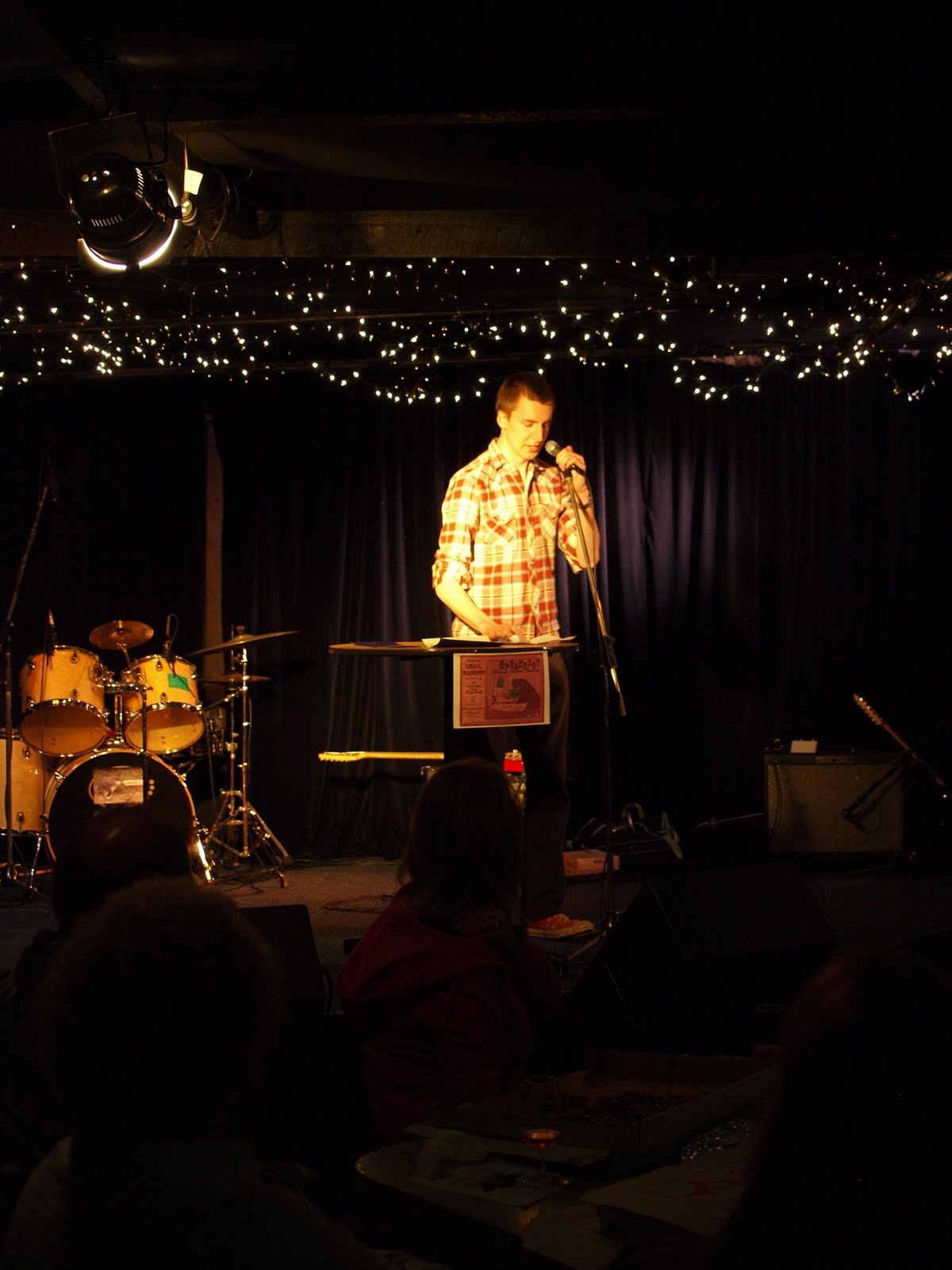 Peter Beaglehole
 Delana Carbone
 Mel Manson
 Alicia Carter
 Miranda Richardson
 Piri Eddy
 Melanie Pryor
 Dennis Wild
 Luke Bartholomew